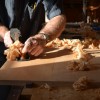
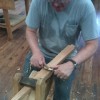
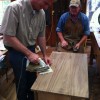
This past week we had a fine keepsake box class and cut many dovetails. We used the cutting gauge for marking the depth of the pins and tails so I would like to take this opportunity to iron out any confusion there may be in regards to a cutting gauge versus a marking gauge. Obviously, a marking gauge is for marking and a cutting gauge is for cutting!
More in depth, a good cutting gauge has a knife blade in it, and a marking gauge simply has a pin. The question is: why wouldn’t you just use a marking gauge for marking out your dovetails? The answer lies in which grain direction we are marking. When laying out dovetails you always mark across the grain. If I use a standard marking gauge with a pin as shown in the picture; working across the grain; we will be scratching the surface and tearing the fibers, leaving an unsightly line.

On the other hand if I use a cutting gauge, which has a single bevel knife blade as opposed to a pin; it cuts and severs the cross grain fibers, leaving a beautifully clean and crisp line across the fibers, as shown in the picture.

So what purpose does the marking gauge have? As a general rule the marking gauge, (which has a pin) is used exclusively with the grain. Most marking gauges are also set up as mortise gauges and will have double pins. Mortises are marked with the grain therefore a pin is not at all a problem. The cutting gauge is most often used across the grain but still can be used with the grain. In the past I have sharpened my marking gauge pin to a knife-edge; the problem with this is that you have to make a double bevel which forces the fibers on either side of the bevel.
My cutting gauge has a bevel on one side only, thus leaving a crisp hard edge with the bevel facing the waste side. A bevel will always bruise the wood; therefore you always want to have the bevel facing the waste side.
I also use the cutting gauge when I am working on cross banding and inlay. It really is my secret weapon for hand tool woodworking. I used it extensively when I made the rose table for cutting across the grain prior to inlay and cutting cross banding to size.
Now the question, where do you find a good gauge? There are a few cutting gauges out on the market, but most are not well made, unless of course, you want to spend a lot of money. Check these out here!
The main problem that I have found with less expensive gauges is that the blades are not configured correctly, that is, they are not sharpened to the right shape. The other problem that I have found is that the wedge that holds the blade in place does not offer a good positive hold.
Faced with the quandary of needing several gauges for a recent dovetail class, I decided to just make some. Here is the finished gauge, and it works fabulously! I hope to write an article on how to make your own, so stay tuned. In the mean time, we are working on a tool making class which will include making your own cutting gauge. We will keep you posted on the details.