An Introduction to the Top Bar Bee Hive

January 31st, 2012

Even if you’ve never kept bees yourself, you’ve probably seen Langstroth hives. Although Langstroths are the most widely used hive among commercial and hobbyist beekeepers, there’s another type of hive.  It offers a number of important advantages, particularly to the homesteader or small-scale beekeeper. This is the top bar hive.

Top bar hive

Top bar bee hive

As a beekeeper and a beekeeping teacher, I have kept both Langstroth and top bar hives for over twelve years and operated them side by side. In this article, I want to describe some of the differences between these two types of hives and show why I think the top bar hive is often the better choice on the homestead.

Langstroth hive

Langstroth hive

The Top Bar Hive

The focus of the top bar hive is on simplicity. It’s a single box hive. Unlike the Langstroth hive, which has multiple different boxes that you add or remove at different times of the year, the top bar hive is completely self-contained. Everything that the bees need to go through their yearly functions is contained in that one box.

The top bar hive differs from the Langstroth both in how the bees build their combs and in how we harvest the honey. Top bar hives have a protective roof. Under that roof, along the top of the hive, are 24 removable wooden bars. (That’s what gives the hive its name.) On each bar hangs a small starter strip, and it’s from there that the bees build their combs.

Langstroth hives, on the other hand, use a wooden frame for each comb. Each frame contains a factory-made foundation, which is a thin piece of wax that has been imprinted on both sides with a series of hexagons, on which the bees will build their cells. The bees will conform their cells to the size of the imprints on the foundation.

comb top bar hive

A comb from the top bar hive

Harvest Your Honey with Household Utensils

When you harvest the honey from a top bar hive, it’s very simple. All you have to do is cut the honey comb off of the starter strip with a kitchen knife, mash it to open up the honey cells and use cheesecloth as a strainer to separate the wax from the honey. The nice thing about this, is you can do it all with very basic kitchen utensils, such as a bowl and a potato masher.

Harvesting honey from the Langstroth hive, on the other hand, requires several specialized tools: a hot knife or capping fork, a capping tank, and an extractor. These tools are expensive, and you’ll only use them for a short time each year while you’re harvesting honey. The rest of the time, they’ll sit idle. To keep bees with Langstroth hives, you’ll need a place to store this equipment, along with the extra hive boxes, and the frames and combs from which you extracted the honey, until you are ready to use them again. Storing the combs also invites a problem with wax moths.

Just the fact that the top bar hive contains everything your bees need for the entire year makes it a lot simpler to manage.

Better Control of the Varroa Mite

Back in the 1950′s, the manufacturers of the foundation material for Langstroth hives began using cell sizes that were slightly larger than what the bees would naturally build. The thinking at the time was that if the cell was larger than normal, the bees would start becoming larger than normal. But that’s not what happened – the bees stayed the same size. So now we have a large cell with a slightly smaller bee in it. Then the varroa mite hit in the 1960′s and 70′s. This mite lays eggs in the cell right about the time that the honeybee larvae is spinning its cocoon. The varroa mite goes through its metamorphosis and develops right along with the honeybee. The larger cell gives the varroa mite just the space that it needs to have a good-sized family. In fact, there will be as many as 3-7 varroa mites in each cell. Varroa mites can be very destructive to a hive, and if you don’t take measures to control them, they can destroy your colony.

The top bar hive helps reduce this whole problem in a very simple but effective way. When the bees build their cells the natural size, which they will do in the top bar hive, they’re just the right size for the developing honeybee. As the honeybee grows, it will fill its cell so completely that often any varroa mites in the cell will die for lack of room. You may still have some varroa mites, but not nearly as many as you’d have in the Langstroth hive, and usually, they won’t be a threat to your colony.

Better Overwintering

Because the top bar hive is horizontal, it holds heat much better than the Langstroth hive, and this makes it easier for the bees to overwinter. During cold weather, bees have to actively work to keep the hive warm. To provide the energy to do so, they consume honey. The Langstroth hive acts almost like a chimney. It is a stack of boxes, and since heat rises, most of the warm air rises to the top. This makes it hard for the bees to keep the lower sections of the Langstroth hive warm.

Improved Top Bar Hive Design

One difficulty we’ve encountered with the top bar hive is that during the hot summers of central Texas, the wax combs will soften in the heat, and they can break under their own weight. To overcome this problem, I’ve worked on the top bar design over the past twelve years to adapt it for our climate. I now have a design that has a shorter, wider comb, which works very well.

Another difficulty, one that beekeepers face each spring, is swarm control.  When a bee hive swarms, it divides in two, and you end up losing half your colony. With this improved top bar hive design, there’s a way to manage the hive that prevents swarming and doubles the size of the pollination force.  We go over this management technique in detail in our hands-on beekeeping workshop.

More Natural Comb Structure

The comb structure inside a top bar hive is very similar to the natural comb structure that honeybees would build in the wild, such as in a log. The queen is free to rotate through the colony and dictate how she wants to build her nest. She can use as much space as she needs to lay her eggs. Usually she’ll use 10-11 combs for brood (sometimes as many as 15). The rest will be available for honey.

inside top bar hive

Inside the top bar hive

In the Langstroth hive, on the other hand, you have to use a queen excluder to keep the queen down in the bottom two boxes because if you don’t, she will lay brood wherever she sees fit, and you’ll end up with combs that have both brood and honey, which would be a problem when it comes time to harvest the honey. Since you’re only giving the queen access to part of the hive, and since this is unnatural to her, you have to monitor how much space she needs, which is difficult to do.

Extra Wax for the Homesteader to Use

In the top bar hive, because you harvest the entire comb when you harvest the honey, you end up with extra wax. A lot of people who learn about the top bar are excited about the prospect of getting extra wax because there are many different uses for it. Every comb will give you about enough wax to make one candle. This may not sound like a lot, but when you’re looking at beekeeping and other homesteading activities from the viewpoint of a larger sustainable lifestyle and culture, the benefits of getting that extra wax are much higher than just returning it back to the bees, as you would in a Langstroth hive.

With the Langstroth hive, when you harvest honey, you cut the wax capping off of the comb with the comb fork or hot knife, and you leave the comb intact, so you’ll barely get a teaspoon of wax per comb. It would take quite a few Langstroth combs to get enough wax to make a candle.

Less Honey Production

The yield on a top bar hive is 3-5 gallons of honey a year versus the Langstroth hive, which will yield 5-10 gallons. For a commercial beekeeper, that’s an important consideration, and Langstroth hives will likely be your best choice, but if you’re looking to get into beekeeping on a smaller scale, as part of a sustainable lifestyle, and without a large investment of time and equipment, you really ought to consider learning more about the top bar hive.

Leave a Reply

Spam protection by WP Captcha-Free

Ploughshare Blacksmithing Teacher to Attend Training at Gransfors in Sweden

January 25th, 2012

Caleb Nolen, Ploughshare Blacksmithing Teacher

Calen Nolen, Ploughshare’s blacksmithing teacher is planning a trip to northern Sweden to attend training at Gransfors Bruks. Gransfors makes hand forged axes using traditional blacksmithing methods and is well known for the quality of their axes. Gransfors was founded in 1902 and is family owned.

Caleb will be attending an eight day blacksmithing class that Gransfors offers on tool making and axe forging. The class covers tool forging, forge welding technique, and forging of the axe. This is an excellent opportunity for Caleb to expand and strengthen his blacksmithing, tool making, and axe making skills by learning from some of the best axe makers in the world.

Caleb is developing tool making classes and curriculum for Ploughshare and will incorporate his new skills and knowledge into these new classes so that others can also benefit.


Tuition, room and board, and travel for this trip are approximately $3,000. If you can help us fund this trip, please click the Donate button above.

2 Responses to “Ploughshare Blacksmithing Teacher to Attend Training at Gransfors in Sweden”

  1. Terry L. Blose says:

    Caleb,
    I’m looking forward to hearing about your trip. I’m also anxiously awaiting the classes on tool making.
    Terry

    • Caleb says:

      Terry,

      Thank you. The class is in mid-July, and we will be posting to let everyone know how it goes. We are very excited about it, as the class will cover some things that we’ve wanted to learn for a long time. We’re looking forward to sharing it with you all, maybe this fall. I am currently developing a class on making tongs and will have that available soon. It is always good to hear from you. — Caleb

Leave a Reply

Spam protection by WP Captcha-Free

How Does Woodworking Fit Into an Agrarian Lifestyle?

January 17th, 2012

Frank Strazza

[This article is based on an interview with Frank Strazza, Ploughshare woodworking instructor.]

Ploughshare: Can you comment on how woodworking fits into an agrarian lifestyle and the restoration of a local cottage economy?

Frank Strazza: In many ways, it seems like we’ve gotten away from simple tasks—working with our hands and using simple hand tools that people have used for generations. It’s only been in the past 50 or 60 years that people have really turned their back on the traditional ways of doing things and rejected the use of traditional hand tools for simple tasks.

Let’s take a hand saw, for example. Until about 60 years ago, when people would frame houses, they would use hand saws to cut framing lumber. A sharp handsaw will cut through 2×4′s as fast as a circular saw.

Suppose you need to build a chicken coop—I built a chicken coop with my children, and instead of using a circular saw, we used a hand saw. Now I’m building a shed, and I’ve been using hand tools because the shed is far away from any source of electricity, and it would take more time and effort to drag an extension cord out there.  It’s faster to do the work by hand, but to do that, you need to have the hand skills. You also need to know how to sharpen the tools because a dull hand saw will not work.

Many people no longer have the skills to sharpen saws.  When they try to use a dull saw, they say, “This doesn’t work.” So they use a circular saw instead because you can buy a brand new, sharp blade at the store for $10-20 and get on with your work. But if you have the skills to sharpen a handsaw, then with five minutes of sharpening, you can cut through wood very effectively and very quickly. Hand tool woodworking fits into an agrarian way of life because you develop skills that you can use in many different projects on your homestead.

As far as fitting into a cottage  economy, I think there are many ways someone can make a living by making projects in their home shop using hand tools (and power tools).  Working out of the home or home shop is very doable. Having made furniture for a living for years as a sole source of income, I can say it’s a lot of work, so you definitely need to love what you’re doing.

2 Responses to “How Does Woodworking Fit Into an Agrarian Lifestyle?”

  1. Mike Mastrangelo says:

    Yes – it was not long ago that handsaws were used for most tasks on the jobsite. My first job in 1973 was as a carpenter’s helper doing mostly renovation work. In each of our tool boxes we had a crosscut saw, a rip saw, a coping saw and a keyhole saw. The crew had a miter box with a crosscut backsaw and a miter trimmer. In trimming out windows and doors, I would cut the trim slightly over with the miter box and then use the trimmer to shave the joint to a precise fit. The coping saw was obviously for coping joints for trim. In 76 I moved to Texas and got a job doing trim carpentry and framing. I still used my handsaws for installing hardwood trim, but by then nearly everyone was using a worm-drive Skillsaw for framing. As far as trim carpentry went, most crews in Central Texas would rough cut the trim and fill in the gaps with caulking compound. They would miter all trim joints – no one seemed to know how to cope a joint. Not long after that, everyone had an electric miter box.

  2. Paul Dennehy says:

    Interestingly enough, people will force a dull circular saw or table saw blade through a board because brute force will get through it. Then they complain about the quality of the cut. It’s all about sharp regardless of the tool. However, there is nothing like the feel of a handsaw and the reasonable assurance that if you started the cut with ten fingers, you’ll end the cut with ten fingers. I think hand tool work heightens observation and attention to your surroundings – a beautiful place to be in complex world.

Leave a Reply

Spam protection by WP Captcha-Free

Ploughshare’s New Classes for 2012

December 20th, 2011

We’ve greatly expanded our class offerings for 2012.  Below is a list of new classes. To find out more about a class or register for it, click the class name.

Gardening

Homestead GardeningThis comprehensive series of gardening classes will teach you how to raise a large portion of your family’s food, sustainably.

  • Gardening I – In this workshop, you’ll learn the foundational concepts and principles involved in gardening and how to select the best site for your garden. You’ll learn about soil and soil fertility, compost, growing beds, watering your garden, and pest control.
  • Gardening II – In this class, you will learn how to plan your garden, how to keep journals and records to improve your results, proper crop spacing, crop rotation, cover crops, how to start seeds, how to transplant, and ways to protect your crops in order to extend the gardening season.
  • Gardening III – The third class builds on the previous two classes. You’ll learn about saving seed from your current garden for next year’s or next season’s garden along with companion planting. We’ll also cover greenhouse design and how to do year-round gardening, so that you can get a food supply from your garden in all seasons.

Sewing

  • Beginning Garment SewingBeginning Garment Sewing – This three day class builds on our Sewing 101-103 class. You’ll learn to make an elastic waist skirt. In this project, you’ll begin developing skills that you’ll be able to apply to other sewing projects. Next, you’ll learn hemming. We’ll teach you four ways to finish raw edges and four different hemming stitches.  Closures are next. You’ll learn how to insert both regular and invisible zippers, make button holes, sew on buttons, attach snaps, and use hooks and eyes. At the end of this class, you’ll have the skirt that you sewed, along with the pattern, a hemming sample book, a closures sample book, and step-by-step instructions for both hemming and closures.
  • Baby Jumper with Pantaloons – In this two day class you will further strengthen and develop your sewing skills.  You’ll make a baby jumper and matching pantaloons.  In making these projects, you will learn more about cutting out sewing projects, sewing a crotch seam, making a French seam, and other skills.
  • Paneled Skirt and Vest with a Collar – In this three day class, you’ll learn simple ways to adjust patterns for proper fit, how to make a one piece collar, and how to insert an invisible zipper. You’ll also learn about facing, understitching, and darts.  At the end of the class, you’ll take home your completed skirt and vest, along with the patterns and well-illustrated instructions.

Quilting

  • Baby quiltBaby Quilt – In this two day class, you’ll learn the basic quilt making skills of fabric selection, rotary cutting, chain sewing, piecing squares, adding borders, laying-up, hand quilting, and making and applying a binding as you begin making a 36″ x 36″ baby quilt.  You will cut out, piece, and lay up your quilt in the class, and we’ll teach you hand quilting and binding, so that you can complete your quilt at home.
  • Table Runner – This one day class is a nice introduction to quiltmaking on a small project.  You’ll learn several quilt making skills, including fabric selection and rotary cutting as you sew an 11 1/2″ x 38 1/2″ table runner. In the class, you will cut out, piece, and lay up the table runner, and you will learn all the skills needed in order for you to complete the project at home.

Crocheting

We are offering three new half-day crocheting classes that will you teach you the basics of crochet along with the three primary crochet stitches. After completing these three classes, you’ll know how to follow any basic crochet pattern.

  • Crocheting 101 – This class is an introduction to crocheting. Learn single crochet then use this stitch to make a potholder, beginning the project with a chain stitch and completing it with a whipstitch.
  • Crocheting 102 – Further your skills as you learn half-double crochet to crochet a cotton dishcloth.  In addition, you will learn to read and follow a crochet pattern.
  • Crocheting 103 – Learn double crochet and make a baby hat using this stitch. In this workshop, you’ll also learn how to increase stitches, check gauge, and make a pompom (for the top of the hat).

Pottery

  • Pottery Basics – This three day workshop is a great introduction to the art and craft of making pots on the potter’s wheel. You will learn to make a cylinder and a bowl first. Then we will teach you some simple shaping techniques and ways to make handles.

Rigid Heddle Weaving

In this series of classes, you will learn a variety of skills and patterns that you can then use as you weave attractive scarves and other projects, such as shawls, cushions, towels, and fabric.

  • Buffalo Check Scarf – In this class, you’ll be weaving a two-color buffalo check scarf and finishing it with an overcast stitch. The scarf will be made of merino wool/tencel yarn.
  • Houndstooth Scarf – You’ll use two shuttles to weave a traditional houndstooth patterned scarf made of merino wool/tencel yarn.  We will also demonstrate fringe twisting.
  • Brooks Bouquet Scarf – In this class, you’ll learn how to make a beautiful Brooks Bouquet lace pattern scarf (Brooks Bouquet is a finishing technique that can be used to weave lace). You’ll be weaving the scarf from cotton/bamboo yarn.
  • Chenille Scarf – The project for this class is a variegated scarf woven from rayon chenille. Chenille makes a soft, attractive fabric that drapes well.  Weaving with chenille requires proper techniques, which we’ll teach you in the class.
  • Pick up Stick Scarf – The pick-up stick is a tool that you can use to manipulate the threads to make complex patterns on your rigid heddle loom. We’ll teach you how to use the pick-up stick, then you’ll weave a scarf using your new skills.  You can use one of three finishing techniques to start and complete the scarf. For this project, you will use pima cotton/modal/silk yarn.
  • Spot Weave Lace Scarf – This class will further your skills with the pick-up stick, as you learn to use two pick-up sticks to weave a scarf using a 5-thread lace (spot weave) design from baby alpaca and silk yarn.

You can also learn to weave a dish towel on your rigid heddle loom:

  • Cotton Bouclé Dish Towel – In this class, you will weave a multi-colored, striped, cotton dishtowel using a slub yarn for the weft.  You’ll learn how to hemstitch both ends of the towel. Hemstitching is a skill that will be useful to you in other types of projects.

Comments are closed.

Learning How to Make Soap at Home

December 15th, 2011

Homemade soaps

Homemade goat's milk soaps

I learned to make soap about 18 years ago and for the past seven or more years have made all the soaps that my family uses. This includes soap for bathing, shampoo bars, laundry soap, soap for washing dishes, gentle soap for babies, and pet shampoo bars containing essential oils that help deter fleas and ticks. The photo shows soaps I’ve made in my home business, which makes and sells goat milk soaps.

In our one day course on soap making, we teach many of the things we have learned as soap makers. You’ll learn through hands-on training how to make soaps using the hot process and cold process methods.  Hot process soaps are usually made from tallow, which you’ll learn how to render. Cold process soaps are most often made from vegetable oils. You’ll learn about the advantages of each method, and at the end of the day, you’ll take home your own soap mold full of soap that you have made in the class. Half of the batch will be hot process soap and the other half will be cold process, goat’s milk soap.  After your soap has cooled and after you’ve cut, shaped, and aged the bars, they’ll be ready for you to use.

We have plenty of time in our soap making class for your questions, and we often cover topics like

  • “How can I make laundry soap?”
  • “Can I actually make all the different soaps that my family needs and uses?”
  • “What about homemade lye?”

We have several books available for purchase at each class so that you can further your soap making skills.  The books cover how to make shampoo bars, molded oval soap, herbal soap, and various other types of soap.

Comments are closed.

Best of Show at the Texas Furniture Maker’s Show

December 7th, 2011
Hand forged table

Hall table made of mesquite, steel, and copper

Caleb Nolen, our blacksmithing instructor at The Ploughshare Institute, won best of show in the 12th annual Texas Furniture Maker’s Show with his hall table. The Texas Furniture Maker’s Show is a juried show that features the work of the finest furniture makers in Texas.

The sides of the piece are hand forged in a serpentine shape that runs in fluidity to the bow front, bringing your attention to the center oval, which showcases a cluster of hand forged roses.

Hand forged roses

Caleb fashioned each rose and its stem from a single piece of steel. The leaves are individually shaped then forge welded to the rose stem. On either side of the oval is a hand hammered copper rose.

Copper rose

Mortise and tenon joints with hand-hammered rivets hold the table together, and the top is made of figured mesquite.

Side view of table

BEST OF SHOW WINNER

Our Blacksmithing instructor at Ploughshare, Caleb Nolan, won best of show in the 12th annual Texas Furniture Maker’s Show with his hall table. The sides of the piece are hand forged in a serpentine shape that runs in fluidity to the bow front, bringing your attention to the center oval, which showcases a cluster of hand forged roses.

Caleb fashioned each rose and stem from a single piece of steel. He individually forged each leaf then forge welded them to the stem. On either side of the oval is a hand hammered copper rose, formed in the traditional repose method, done entirely freehand. The table is joined together with mortise and tenon joints and hand-hammered rivets, and the top is made from a fine piece of figured mesquite.

The piece is on display November 10 through December 10, 2011 at the show in Kerrville, Texas. The Texas Furniture Maker’s Show is a juried show that features the work of the finest furniture makers in Texas. Most entries in the show are constructed of wood, but entries also include materials as diverse as metal, stone, and fabric.

Comments are closed.

Ricotta: A Simple Cheese You Can Make at Home

December 2nd, 2011
Homemade ricotta cheese with blueberries

Homemade ricotta cheese with blueberries

Ricotta is a soft cheese that you can easily make at home. It is excellent eaten fresh with fruit, or you can use it in baked dishes like lasagna or baked ziti.

The recipe below, based on whole milk, is one of the simplest ways to make ricotta cheese. In our one day soft cheese making class, we teach another approach, where you first make fresh mozzarella, then make ricotta from the leftover whey.

This recipe makes about 1 3/4 pounds or 4 cups of ricotta.

Ingredients

  • 1 gallon whole milk
  • 1 teaspoon salt
  • 1 teaspoon citric acid

Instructions

Combine the milk, salt and citric acid in a large stainless steel pot, and mix the ingredients thoroughly.

Pouring the ingredients into a large stainless steel pot

Heat the mixture over medium heat on the stove top, stirring very gently to prevent scorching. Be careful not to stir too much because that will cause the curds to be too fine. Heat until the temperature reaches 195 degrees (F), but don’t allow the milk to boil. By the time the mixture reaches 195 degrees (F), the curds should have begun to separate from the whey.  When this happens, turn off the heat and let sit for 5 minutes.

Ricotta curds forming

Line a colander with butter muslin or fine mesh cheesecloth and set it in the sink (or in a pot, if you want to save the whey).  Scoop the curds and whey using a two cup measure and gently pour them into the colander.

Draining the Ricotta Curds through Cheesecloth

Draining the ricotta curds through cheesecloth

Drain the curds until they are the consistency you want.  The longer you allow them to drain, the drier your ricotta will be. You can eat it right away or store it in the refrigerator for up to two weeks. It also freezes well.

The final product: 1 3/4 pounds ricotta cheese and 3/4 gallon whey

2 Responses to “Ricotta: A Simple Cheese You Can Make at Home”

  1. Debbie Leverett says:

    Hello Rebecca, I attended the cheese classes you offered a couple of years ago along with my sister and mom. I have a question. All my cheeses look good, texture is fine, but I am somewhat disappointted in the taste, or rather lack of taste. I feed a good grain, and grass so I don’t think it is the feed. My mozerella is ok, but again something is missing. Can you tell my what Lipase does to cheese? or “Enzymes” I have a very sensitive nose and can detect when it just isn’t right. I think of ya’ll often and keep up with all the awards you have been getting. Good luck, Blessings, Debbie

    • A lot of the taste in soft cheeses come from the amount of salt you add, or the length of time it sits, depending on the recipe. For your mozzarella, you might want to try stretching it in salt water. If that doesn’t help, add a little salt to the mozzarella while you are stretching it. Just sprinkle it on the surface. For hard cheese, the taste has to do with how long your cheese ages. The flavor doesn’t start to fully develop until at least 7 weeks in hard cheese, so make sure that you are aging them at least that long. Lipase is an enzyme that is commonly added to Parmesan and Feta to help produce the sharp flavor. Both rennet and lipase are enzymes, and are often listed on cheese labels as “cheese enzymes”, but are not something that you purchase separately to add to your cheese. Hope this helps.

Tools to Setup Your Home Blacksmith Shop

November 22nd, 2011
Blacksmithing

Making nails

Setting up a home blacksmith shop is not that difficult. You can get everything you need for about $300-500 if you buy used equipment and make what you can yourself. The main tools you’ll need to get started are a forge, an anvil, a vice,  hammers, and tongs. One of the great things about blacksmithing is that you can make many of the tools yourself, as you go.

Forge

The forge is what you’ll use to heat the metal that you’re working. It consists of a firepot, to hold the fire, a work surface, and a blower. The firepot should be about 4-5 inches deep, and can be made from an old brake drum. The forge I use is made of brick and firebrick and is more substantial, but I’ve also seen forges on old farms made from concrete poured into a tractor tire, with a depression for the firepot. You can find blowers in antique stores or salvage them from air conditioning units, clothes dryers, or other used appliances. My dad’s first forge was basically a brake drum with legs. The blower was an old hair dryer!
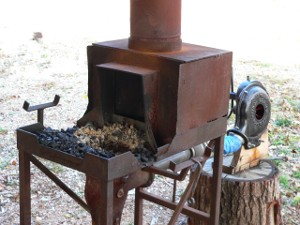
Blacksmith's forge

Small forge and blower

Anvil

Unless you have a lot of money to spend, it’s best to start with a used anvil. You can find them for about $1-2 per pound. Even if an anvil has some dings, it can be cleaned up and resurfaced if necessary, and it will work just fine. A “wanted” ad in the paper is a good way to find these and other blacksmithing equipment. We’ve also found anvils and other blacksmithing equipment at farm sales, estate sales, and farm auctions.
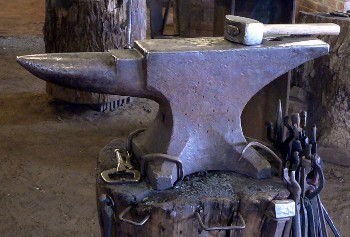
Anvil

Anvil and other tools

Hammers

You can start with a basic ball pein or a cross pein hammer. You can usually find these at local hardware stores. You can also order various types of blacksmith hammers from a blacksmith supply house. Once you develop some skill with blacksmithing, you’ll be able to make hammers.
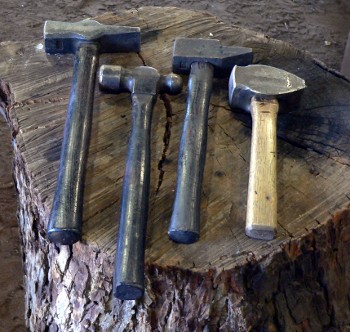
Blacksmith's hammers

Ball pein and cross pein hammers

Vice

There are two main types of vices, the post vice and the machinist’s vice. A post vice is the blacksmith’s vice. It is designed to stand up to the hammering. Machinist vices, particularly the smaller ones, can be damaged from the repeated hammer blows. The place to look for post vices is farm auctions and estate sales. If you’re not able to get a post vice, you can start with a machinist’s vice. It’s best to get a larger vice that will stand up to the hammering well, and you’ll need to fit it with smooth jaws so that it won’t mar the workpieces.
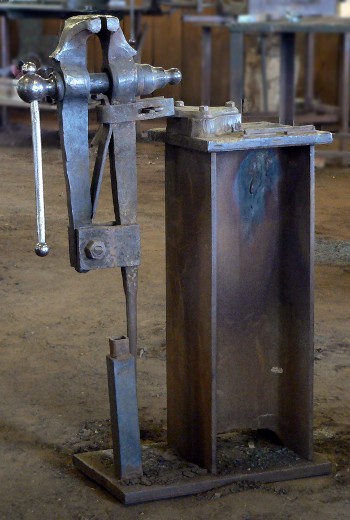
Post vice

Post vice

Tongs

Over time, you’ll need many different tongs, one or two for each thickness of metal that you work with. Having tongs that are the right size for your materials makes it much easier to keep a good grip on your metal and improves the quality of your work. But for starters, you only need about 1-2 pairs, which you can buy for $30-40 each from a blacksmith supplier. After you’ve gained some experience blacksmithing, you’ll be able to make your own tongs. Usually by the end of our two day blacksmithing class, our students are ready to begin learning the skills of tong making.
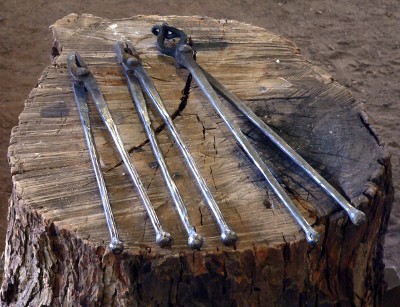
Blacksmith's tongs

Three types of tongs

Other Tools

You’ll also use drifts, slitters, center punches, twisting tools, and chisels. These are all tools that you will be able to make yourself as you develop your skills.
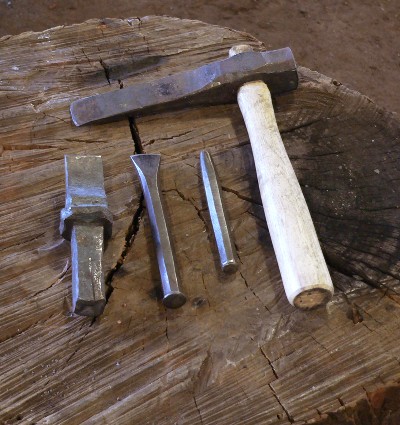
Blacksmith's Tools

Tools made by the blacksmith: hardie cutoff, cold chisel, center punch, and set hotcut

Comments are closed.

Beekeeping for Pollination

November 16th, 2011

Honeybee with pollen on its back legs

There are many good reasons to keep bees, but one reason that’s often overlooked is pollination. Although some crops like corn and small grains are pollinated by wind, most crops in your garden or orchard depend on insects for pollination and will not properly produce fruit without it. Examples include tomatoes, cucumbers, squash, okra, onions, watermelon, cantaloupe, blackberries, apples, apricots, strawberries, and many others. Other crops, such as broccoli and cabbage will produce a head without pollination, but they require pollination in order to set seed, so if you’re planning to save seed for next year’s garden, you’ll need pollinators for those crops also.

Cucumbers and squash, depending on the variety, require as many as 8 to 12 visits per flower in order to set fruit properly. Apples need about 8 visits per blossom to produce good quality fruit. In our beekeeping class, I often bring a misshapen apple to the class, one that is large and well developed on one side and small and poorly developed on the other side. When we cut the apple open and look inside, we invariably find that the well developed side contains more seeds than the smaller, poorly developed side because the seeds stimulate the growth of the fruit.

Honeybee on cantaloupe flower

Honeybee on cantaloupe flower

The best way to ensure that your crops are pollinated well is to have a bee hive nearby. Honeybees form large colonies, having 30,000 – 40,000 bees in a single colony during winter and increasing in size during the Spring. Honeybees actively collect and store pollen in their hive because they depend on it as a food source for their young. The way that honeybees collect the pollen makes them especially good pollinators.

Honeybee in the hive with pollen

Honeybee in the hive with pollen

There are several types of wild pollinators, such as mason bees, bumblebees, and butterflies, but none of these are as effective as the honeybee. Mason bees are good pollinators, but they are solitary bees and do not form colonies. This means their workforce in your garden is small compared to a honeybee colony. Bumblebees form colonies, but each bumblebee colony begins with a single queen bee in early Spring and only grows to about 600 bees by its peak later in the year, so although they are an important pollinator, they are less effective than the honeybee. Butterflies tend to mainly feed on sweet nectar producing blossoms, and they do not collect pollen, so although they do contribute to pollination, they have a much smaller effect than honeybees.

If you want your garden and orchard to be pollinated well so that all your plants will set fruit, we recommend having a bee hive on your property. Honeybees often range up to 2 miles or even further in their search for nectar and pollen, but they will concentrate more heavily on the areas closest to the hive.

Beekeeping is not difficult or expensive to get started with. It takes a small amount of time to setup your first hive, and once the hive is established, you will need to check on it every 10-14 days. I tell my students that anyone who can garden can keep a beehive.

If you would like to learn more about beekeeping, we offer a beginning workshop on how to keep bees and a more  advanced hands-on beekeeping and hive management workshop. Together these two beekeeping classes will teach you everything you need to know to get started. We also discuss beekeeping along with other important topics in our 3-day homesteading seminar.

Comments are closed.

Our Plans to Build a Wood Fired Kiln

November 8th, 2011

Pottery from Our Existing Gas-Fired Kiln

We currently use a gas-fired kiln that we built about 10 years ago. We have fired a lot of pottery in this kiln over the years, and in many ways it has worked well for us, but it has a fundamental design flaw that makes the kiln very difficult to use, especially with certain types of glazes.

Types of Kilns

There are two basic types of fuel fired kilns: natural draft kilns, and forced air kilns. A natural draft kiln uses the draft produced by the chimney to pull air into and through the kiln, and dampers are used to regulate the atmosphere within the kiln. A forced air kiln, such as ours, uses fans to blow the flame from the kiln’s burners into the firing compartment where the pottery is located. This type of kiln doesn’t need any secondary draft, such as that produced by the chimney, and in fact any secondary draft makes the atmosphere inside the kiln difficult to regulate.

The Problem with our Existing Kiln

The chimney on our kiln is too large in proportion to the rest of the kiln. Because of this, it produces some secondary draft, which causes turbulence. The draft also makes it hard (or impossible, depending on weather conditions) to regulate the atmosphere inside the kiln.

Our existing gas fired kiln

When firing pottery, one very important stage in the process is the reduction stage, in which firing temperatures are in the 1,600 to 1,900 degree range (Fahrenheit), and the air intake is adjusted to reduce the amount of oxygen in the firing chamber. This “oxygen poor” environment draws out oxygen that is stored in the chemical makeup of the glazes. This  causes the glazes to change to the proper colors.

If there is too much oxygen in the air, the glazes will not change color properly, and if there is too little oxygen, the fire will become sooty, producing a lot of carbon, which also interferes with the glazes. It is important to get just the right oxygen content, and that is what we are unable to do with this kiln.

Red Glazes Turn White

This has been most apparent when we have used red glazes. If the oxygen level is incorrect during the reduction phase, the red pieces turn white. Sometimes the whole piece turns white. Other times, part of the piece will turn white.  Once the piece has been fired, certain minerals in the glazes have been vaporized, and re-firing the piece will not correct the problem. We no longer fire red pieces in this kiln because it is impossible to fire them reliably. In the photo below, both pieces of pottery were glazed with a red glaze, but due to the incorrect atmosphere in the kiln, the pot on the left turned white. The piece on the right turned red in most places, but turned white near the rim.  Although the glaze color does not affect the usefulness of a piece of pottery, it does make the piece unsalable when part of a custom order.

"Red" pottery fired in our existing gas kiln

Our signature Homestead Green pottery also is difficult to fire in this kiln. The effect is less pronounced than for the red pieces, but still very noticeable. Normally, the glazes produce a beautiful translucent, opalescent finish, but when the kiln’s atmosphere is incorrect, the finish becomes metallic green.

A Sustainable Wood-Fired Kiln

Because of these problems, we plan to begin building a new wood-fired kiln very soon. It will be a double fast fired kiln and will use only renewable resources (wood, which is plentiful here). It will require no electricity to operate. We are working toward sustainability in our community, and this kiln will take us another step toward developing a sustainable pottery shop and teaching facility.

We’ve discussed the kiln design with a number of other experienced potters, and we feel that this particular design is the best suited to our needs. There are several types of wood kilns, but this particular type will let us produce pottery that is very similar to the pottery that we currently fire in our gas kiln.

Once we have built the new kiln, we plan to operate it alongside our existing gas kiln until we have gained enough experience with it. Then we plan to dismantle the gas kiln and build a second wood kiln using its materials.

The wood fired kiln will cost about $5,000 to build. It will contain more than 1,500 fire bricks, and most of the cost of the kiln is the cost of the fire bricks.

If you would like to help build this kiln by giving a donation, please visit the donations page on our website or contact us by email. Even a small donation of $4.00 is enough to buy a firebrick. We appreciate any and all support.

We’d Like to Hear from You

Have you used a wood-fired kiln?  What kind? How well has it worked for you? Have you run into any difficulties with it?

Comments are closed.