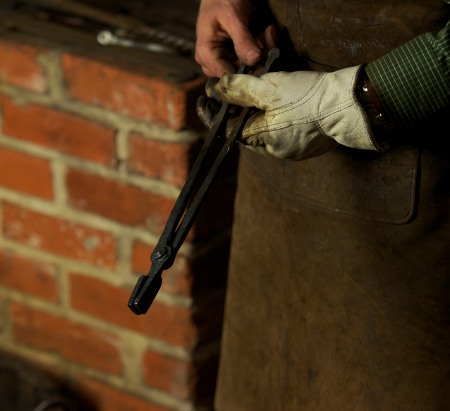
Category Archives: Blacksmithing

Trip Report: Ax-Making at Gransfors Forge

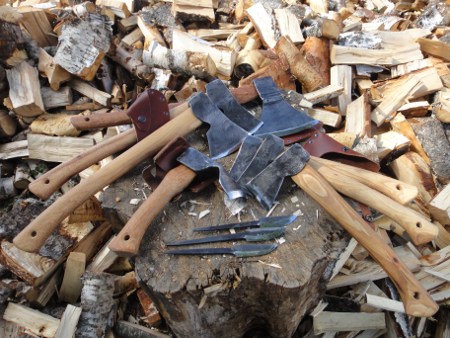
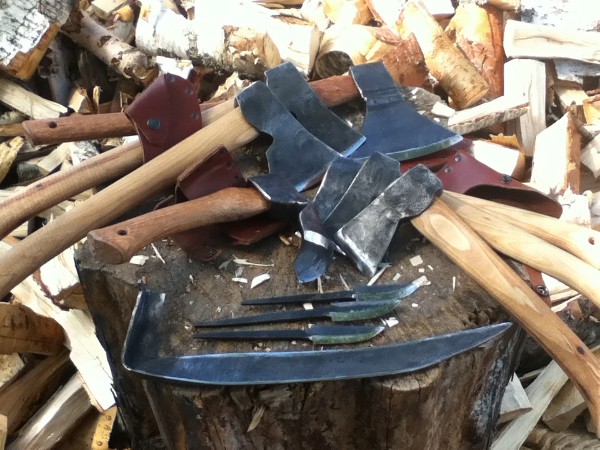
Tools Caleb made in the Class

These are the finished axes and laminated knife blades I made in the class.

Gransfors has a forge, a pottery shop, a museum and a cafe. The first morning there, I took some time to wander around the shops and the museum. I watched and talked to one of the ax makers who has worked there for over twenty-five years.

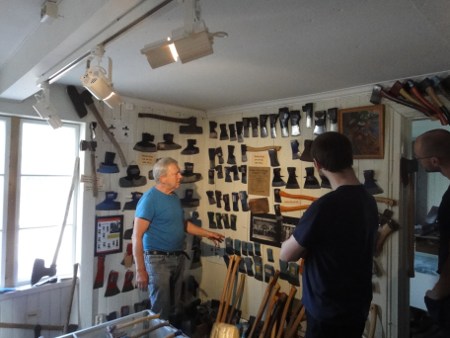
Gransfors Museum

Tour of the museum. Gabriel Branby (left) is the CEO of Gransfors.

They have had an unusually cool and wet spring in Sweden, and everything is very green. The flowers are gorgeous.

Gransfors Bruks

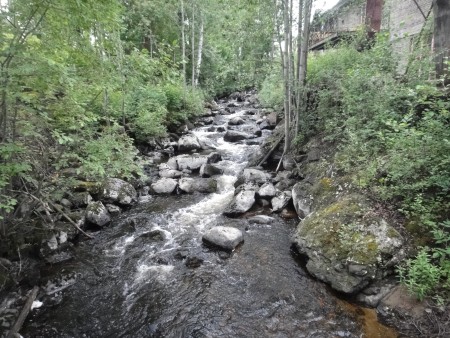
The creek that runs behind and forms the border of the Gransfors property.

In the ax-making workshop that I’m taking, there are eight students, including me.  The other students are from England, Denmark, France, Wales, Sweden and Germany.  We are quite a cross-section from our occupations also, ranging from computer techs to military civil engineers and from gardeners (what we would call lawn work in the U.S.) to blacksmiths.

Ax-making class

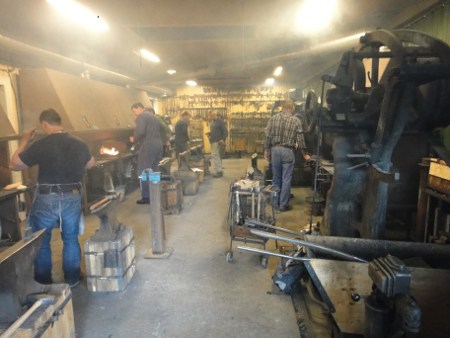
The ax-making class.

Lars Enander is teaching the class. Lars is a native Swede. His teaching method is European in that he wants to let you figure things out on your own. He kind of gets you headed in the right direction and lets you go without a lot of explanation. But he is also very willing to answer questions if you ask. He is a very knowledgeable and helpful instructor and went out of his way to make sure that I learned a lot during the class.

Lars Enander

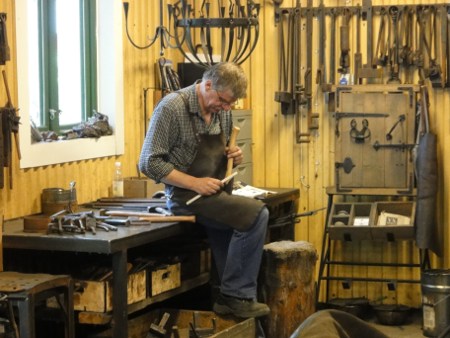
Lars Enander, our instructor, preparing for the next session of the ax-making class.

Lars started the class by giving us each a bar of 3 1/2 cm x 2 cm steel to make a slitter that we will use to punch the eye of our ax later in the class. We also made a set hot-cut from a piece of 33 mm x 37 mm bar. I also had time to make a drift. I also started making a candle holder and a rose while waiting for the other students to finish.

Making slitter

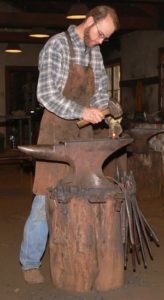
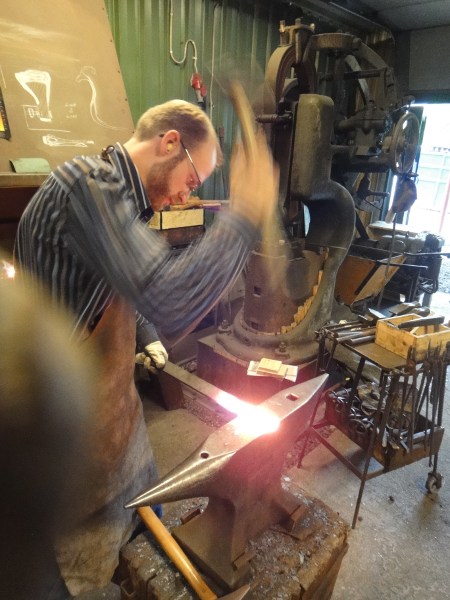
Here I am, making a slitter that I will later use when making axes in the class.

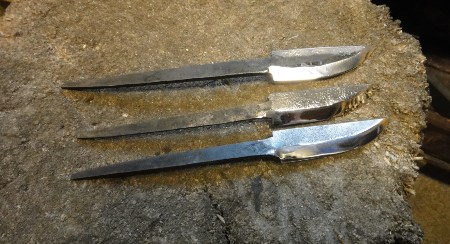
July 12: While the other students were finishing their hot-cuts and tongs, I finished making the candle holder.  When everyone had finished the tongs that we made to hold our axes while we work on them, Lars showed us how to make a laminated knife blade by folding the end of a piece of mild steel flat bar (approximately 1/8 x 3/4″ flat) over 2 1/2″ or so and placing a piece of carbon steel the same width and thickness and two inches long in between.

Tool racks

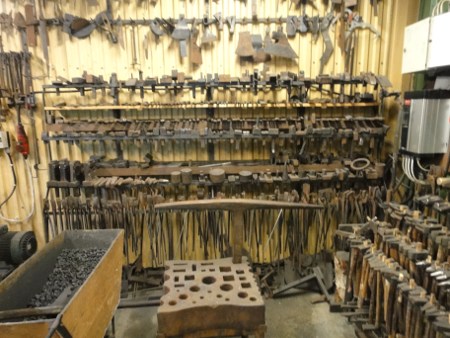
A view of the tool racks.

We left a little space in the fold of the mild steel that will be welded and then drawn for the tang. We then forge-welded the “sandwich” and cut the bar off at an angle, removing the end of the welded pieces to remove anything that did not weld. The purpose of this exercise was mainly to give us practice forge welding carbon steel between mild steel, which we will be doing in making our axes.

Laminated knife blades.

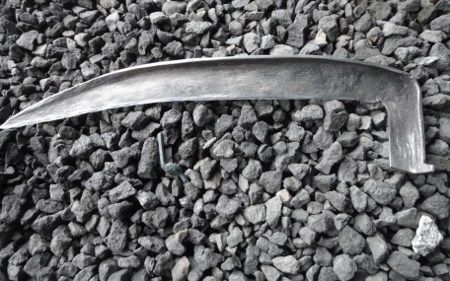
July 13: I made three knifes before lunch, and Lars asked if there was anything he could help me make, such as tools I might need. I told him that I would like to make a scythe, but I didn’t know if that was something we could do. He said that he should know something about that . . . . So I made a couple of tools that would be used when shaping the scythe and started a small scythe, which I finished today. It was only about 18″ long and not perfect, but it works, and I learned a lot and had a lot of fun making it.

Scythe blade

The scythe blade that I made during the class.

July 16: The last three days we have spent making axes! The method we learned is very old and was used in times past, when steel was hard to make and not readily available. They would make the body of the ax out of wrought iron and laminate a piece of steel into the edge, which is the only place that needs to be hard.

Seating the edge steel

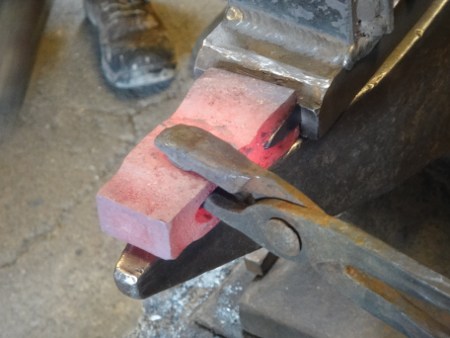
Seating the edge steel into the mild steel of the ax head.

Thank you to everyone who contributed toward this trip.

Caleb Nolen

Coal for Blacksmithing

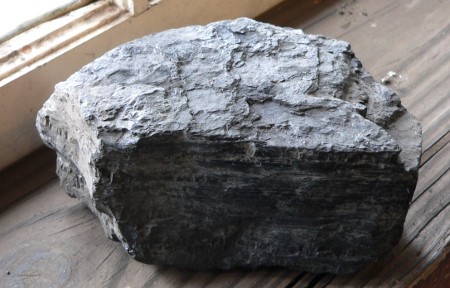
Bituminous Coal

Bituminous coal

Introduction

There are a number of fuels you can use to heat iron for blacksmithing. For most of our work at Heritage Forge, we use coal. Coal is available in several grades, including lignite, bituminous and anthracite. In this article, I discuss the ranking of coal, the type of coal best-suited for blacksmithing and several important points related to the use of coal in your forge.

Grades of Coal

Coal consists primarily of carbon and secondarily of hydrogen, sulfur, oxygen and nitrogen, along with other metallic and non-metallic elements and minerals. Coal is classified both by rank and grade. There is a lot that could be said about rank and grades of coal, but I will stick to what is most relevant to blacksmiths. Coal’s rank is determined by the amount of water, volatile matter and elemental carbon in the coal, as well as its heat content, also known as its calorific value (measured in BTUs). A higher rank coal contains less moisture and volatile matter than a lower rank and has a higher heat content. Grade has to do with coal’s economic value and depends on the amount of minerals, or impurities, contained in it. The composition of coal depends on the conditions in which it was formed, and in some cases, a low-rank coal may be of a higher grade than a high-rank coal. Though additional ranks of coal exist, as blacksmiths, we are concerned mainly with these three: lignite, bituminous and anthracite.

Lignite

Also known as brown coal, lignite is the softest and lowest rank of coal. It is not far removed from peat in its composition and appearance, and it has a distinctly woody texture. Lignite is generally either strip-mined or mined in open pits. Most Texas coal is low-grade lignite, used mainly to power electric plants. As a rule, lignite contains the highest proportion of nonburnable minerals and sulfur of any rank of coal.

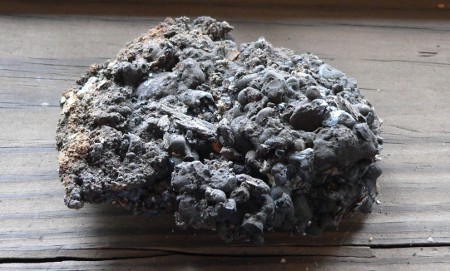
Clinker

Clinker

When you burn any type of coal, the nonburnable minerals in the coal, such as metals and silicas, will melt and coagulate in the bottom of the firepot, forming a sticky semi-solid mass known as “clinker”. As clinker builds up, it will begin to block the forge’s air flow and draw heat away from the fire. In fact, that is why old-timers called clinker a “thief”. Because clinker emits contaminants in a hot fire, its presence, even in small amounts, will inhibit forge welding. Although lignite can be used in a forge, it will produce more clinker than any other grade of coal, making it poorly-suited for blacksmithing.

Bituminous

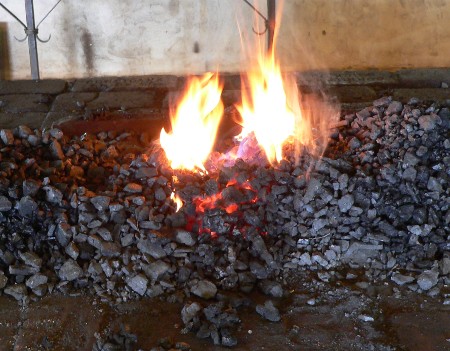
Bituminous is the coal-of-choice for the blacksmith. It is a soft, mid-grade, black coal. Mined from deeper mines than lignite, it burns much more cleanly. When burning coal in the forge, we keep a “stock pile” of wet coal on the sides of the fire. As it smolders, most of the impurities are burned away, leaving primarily carbon, in the form of what we call coke.

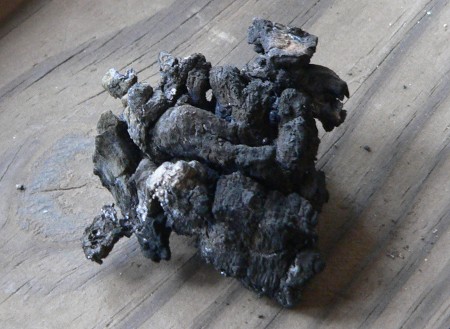
Coke

Coke formed by heating bituminous coal in the forge

Having been reduced, coke burns very cleanly and hot, and it is what we heat the steel with. When you properly build and maintain a fire in the forge using bituminous coal, it will produce coke that sticks together in large chunks. The heart of the fire emits a very intense light that can be harmful to your eyes, but by maintaining the fire properly, the smith can keep the heart of the fire covered by a dark layer of coke to shield his eyes from the intense light.

Bituminous has a low sulfur content, which is important for several reasons. Sulfur lowers the quality of the coke, contaminating the steel you are working and causing it to become brittle. It also pollutes the air with sulfur dioxide and sulfur trioxide. When combined with oxygen and water, it forms sulfuric acid, which is very corrosive to all the metal parts of the forge and chimney.

Coal fire in the forge

Coal fire in the forge

Anthracite

Anthracite is the hardest and highest rank of coal available. It is considered a metamorphic rock. When split, it has a bright, shiny cleavage. Anthracite is generally the cleanest burning coal, and it contains the most energy (BTUs) per pound. However, unlike bituminous, the pieces of coke that anthracite produces are small and tend to blow up and out of the fire. Because of this, it also does not shield the smith from the brightness of the heart of the fire and is not as commonly used for blacksmithing.

In the U.S., anthracite is mined from deep mines in small areas of Pennsylvania and Oregon. An interesting historical fact is that during the American Civil War, blockade runners used anthracite to fuel their steam boilers. Any smoke would give them away, but anthracite was so clean-burning that it produced no visible smoke.

Conclusion

In conclusion, bituminous is the best coal for the blacksmith. It is relatively clean-burning, cokes up nicely, making it easy to manage the fire well, and it produces relatively little clinker. Some of the best bituminous coal in the south is taken from mines near Birmingham, Alabama, which are the source of the coal we use at Heritage Forge.

Making Tongs for Blacksmithing

Tongs

Blacksmith's Tongs

It’s essential in blacksmithing to have good sets of tongs so that you can firmly the hold hot metal that you’re working with.  You’ll need different sizes and styles to match the thickness and shapes of the metal that you’re using in your projects. A blacksmith can’t have too many pairs of tongs.

We have recently developed a tong-making class for blacksmithing students who’ve taken our Blacksmithing I and II classes. This tutorial shows one approach to making a simple set of tongs. If you have some blacksmithing experience and haven’t yet made tongs, you may want to try this on your own. If you think you might need more help and oversight, then you may want to register for our new class, which will teach several methods of tong-making.

Tongs are made of three pieces of metal — two long side pieces that work similar to the side pieces in a pair of scissors and a rivet that holds the side pieces together and allows them to pivot. In each side piece, there are three segments — the jaw, the boss, and the rein.  The left and right sides of the tongs are identical in shape. In other words, they’re not mirror images of one another. If you flip one side over, it will fit together and line up perfectly with the other side.

For this project, we will use 1/4″ x 3/4″ x 8″ mild steel. This lightweight stock is easy to work with and will make a lightweight set of tongs that work well for holding light stock. Using slightly thicker 5/16″ x 3/4″ stock would make a very nice set of tongs for general work.

There are different styles of tongs. The set that we’re making here will hold flat and square metal, but you can modify the jaws of your tongs to hold other sizes or shapes of metal.

Mark the Stock with Soapstone

Mark the stock with soapstone, 1 1/4″ from the end to define the jaws and 1″ from that mark to define the boss.

Marking the jaw and the boss with soapstone

Marking the jaw and the boss with soapstone

 Mark the Stock with a Center Punch

Because the soapstone will not be visible when the steel is hot, also mark the stock with a center punch. When doing this, mark opposite edges as shown in the diagram.

Marking the tongs

How to mark the tongs


Marking the edge with a centerpunch

Marking the edge with a centerpunch

Define the Boss

Using a half-face hammer blow on the far side of the anvil, define the boss by indenting both edges, as shown below. Later we will slit and drift the boss to make a round hole for a rivet that will be the pivot and joinery of the tongs.


Defining the boss

Defining the boss

Drawing Out, Rounding and Plenishing

Draw out the reins to the desired length by hammering on alternate edges.

Drawing out the reins

Drawing out the reins

As you draw out each section to its finished dimension, complete the work by breaking the corners (hammering the corners so as to round or bevel them) and plenishing (hammering at a lower temperature to smooth the steel and remove any large hammer marks, as shown below).

Break the corners and plenish

Break the corners and plenish

Compare and Adjust the Length

Hold the two side pieces side-by-side to compare the length.  If one is longer than the other, draw out the length until both pieces match.

Compare the length of the two sides

Compare the length of the two sides

Twist the Jaw

Clamp a side piece in the vice and make a short 90 degree twist right at the junction between the boss and the jaw, as shown in the sequence of photos below. Repeat with the other side piece. Remember that these pieces should be turned the same direction.

Twist the jaw

Twist the jaw

Hammer the Jaw and Boss

Gently hammer the corners of the twist smooth, so that the jaw and the boss are smooth and square.

Hammer the jaw and boss

Hammer the jaw and boss

Mark the Hole for the Rivet

Use a centerpunch to mark the hole for the rivet.

Mark the location of the hole with a centerpunch

Mark the location of the hole with a centerpunch

Cutting with the Slitter

Begin to cut the rivet hole using a slitter that is 3% bigger than the size of the rivet you will use. In this case, 3/8″ is the rivet size.  The reason for the 3% increase is both to allow for shrinkage that occurs when the steel cools and to enable the rivet to pass through easily.  Orient the slitter lengthwise through the boss.

Using the slitter

Using the slitter

Mark the Hole from the Other Side

When you have cut most of the way through and while you still have a little heat left, flip the piece over, and you will see a shiny spot which is where the slitter will come through.  With the slitter, mark the hole in the center of this spot, and on the next heat, cut through from that side.

Shiny spot on the back

Shiny spot on the back

Drive the Slitter Through

Drive the slitter all the way through to open up the hole.

Drive the slitter through

Drive the slitter through

Round the Hole Using the Drift

Using a drift that is 3% larger than the rivet, drive it through, working from each side alternately.

Using the drift

Using the drift

After Using the Drift

After you have used the drift, the hole will be round, as shown below.

Round hole for the rivet

Round hole for the rivet

Heating the Rivet

Use a rivet whose length is the combined thickness of both sides of the tongs plus 1 1/2 times the diameter of the rivet. In the fire, first pack the coke so that the rivet won’t fall through, then set the rivet on top. Keep an eye on it so that you don’t lose it or burn it up.

Heating the rivet

Heating the rivet

Insert the Rivet

Put the rivet through the hole and hammer it down.

Hammering down the rivet

Hammering down the rivet

Freeing the Tongs

When you finish setting the tongs, they should be too tight to move. Heat them  and work them back and forth while they’re hot in order to free them.

Work the tongs back and forth while hot

Work the tongs back and forth while hot

Adjust to Fit the Stock

Adjust the tongs in the vice to fit them to the size of the stock and align the reins.

Adjust the tongs to fit the stock

Adjust the tongs to fit the stock

Work the Tongs While Quenching

Work the tongs while quenching them; otherwise, they will get stuck.

Work the tongs while quenching

Work the tongs while quenching

The Finished Tongs

Below is a photo of the finished tongs, ready for use.

The finished tongs

The finished tongs

If you make a set of tongs from this tutorial, please let us know. We’d like to hear how the project went and whether you ran into any difficulties.


Ploughshare Blacksmithing Teacher to Attend Training at Gransfors in Sweden

Caleb Nolen, Ploughshare Blacksmithing Teacher

Caleb Nolen, Ploughshare’s blacksmithing teacher is planning a trip to northern Sweden to attend training at Gransfors Bruks. Gransfors makes hand forged axes using traditional blacksmithing methods and is well known for the quality of their axes. Gransfors was founded in 1902 and is family owned.

Caleb will be attending an eight day blacksmithing class that Gransfors offers on tool making and axe forging. The class covers tool forging, forge welding technique, and forging of the axe. This is an excellent opportunity for Caleb to expand and strengthen his blacksmithing, tool making, and axe making skills by learning from some of the best axe makers in the world.

Caleb is developing tool making classes and curriculum for Ploughshare and will incorporate his new skills and knowledge into these new classes so that others can also benefit.


Best of Show at the Texas Furniture Maker’s Show

Hand forged table

Hall table made of mesquite, steel, and copper

Caleb Nolen, our blacksmithing instructor at The Ploughshare Institute, won best of show in the 12th annual Texas Furniture Maker’s Show with his hall table. The Texas Furniture Maker’s Show is a juried show that features the work of the finest furniture makers in Texas.

The sides of the piece are hand forged in a serpentine shape that runs in fluidity to the bow front, bringing your attention to the center oval, which showcases a cluster of hand forged roses.

Hand forged roses

Caleb fashioned each rose and its stem from a single piece of steel. The leaves are individually shaped then forge welded to the rose stem. On either side of the oval is a hand hammered copper rose.

Copper rose

Mortise and tenon joints with hand-hammered rivets hold the table together, and the top is made of figured mesquite.

Side view of table

BEST OF SHOW WINNER

Our Blacksmithing instructor at Ploughshare, Caleb Nolan, won best of show in the 12th annual Texas Furniture Maker’s Show with his hall table. The sides of the piece are hand forged in a serpentine shape that runs in fluidity to the bow front, bringing your attention to the center oval, which showcases a cluster of hand forged roses.

Caleb fashioned each rose and stem from a single piece of steel. He individually forged each leaf then forge welded them to the stem. On either side of the oval is a hand hammered copper rose, formed in the traditional repose method, done entirely freehand. The table is joined together with mortise and tenon joints and hand-hammered rivets, and the top is made from a fine piece of figured mesquite.

The piece is on display November 10 through December 10, 2011 at the show in Kerrville, Texas. The Texas Furniture Maker’s Show is a juried show that features the work of the finest furniture makers in Texas. Most entries in the show are constructed of wood, but entries also include materials as diverse as metal, stone, and fabric.

Tools to Setup Your Home Blacksmith Shop

This article was also featured in the Winter 2012 issue of the SustainLife journal.
Blacksmithing

Making nails

Setting up a home blacksmith shop is not that difficult. You can get everything you need for about $300-500 if you buy used equipment and make what you can yourself. The main tools you’ll need to get started are a forge, an anvil, a vice,  hammers, and tongs. One of the great things about blacksmithing is that you can make many of the tools yourself, as you go.

Forge

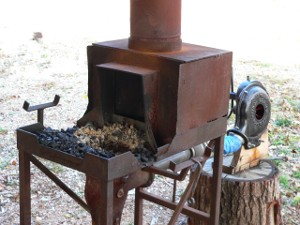
The forge is what you’ll use to heat the metal that you’re working. It consists of a firepot, to hold the fire, a work surface, and a blower. The firepot should be about 4-5 inches deep, and can be made from an old brake drum. The forge I use is made of brick and firebrick and is more substantial, but I’ve also seen forges on old farms made from concrete poured into a tractor tire, with a depression for the firepot. You can find blowers in antique stores or salvage them from air conditioning units, clothes dryers, or other used appliances. My dad’s first forge was basically a brake drum with legs. The blower was an old hair dryer!
Blacksmith's forge

Small forge and blower

Anvil

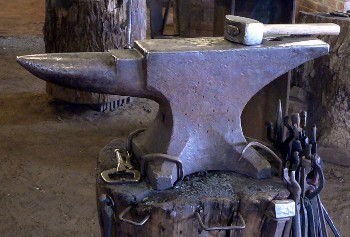
Unless you have a lot of money to spend, it’s best to start with a used anvil. You can find them for about $1-2 per pound. Even if an anvil has some dings, it can be cleaned up and resurfaced if necessary, and it will work just fine. A “wanted” ad in the paper is a good way to find these and other blacksmithing equipment. We’ve also found anvils and other blacksmithing equipment at farm sales, estate sales, and farm auctions.
Anvil

Anvil and other tools

Hammers

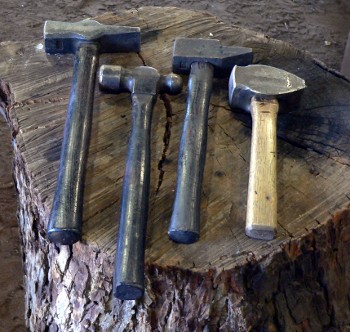
You can start with a basic ball pein or a cross pein hammer. You can usually find these at local hardware stores. You can also order various types of blacksmith hammers from a blacksmith supply house. Once you develop some skill with blacksmithing, you’ll be able to make hammers.
Blacksmith's hammers

Ball pein and cross pein hammers

Vice

There are two main types of vices, the post vice and the machinist’s vice. A post vice is the blacksmith’s vice. It is designed to stand up to the hammering. Machinist vices, particularly the smaller ones, can be damaged from the repeated hammer blows. The place to look for post vices is farm auctions and estate sales. If you’re not able to get a post vice, you can start with a machinist’s vice. It’s best to get a larger vice that will stand up to the hammering well, and you’ll need to fit it with smooth jaws so that it won’t mar the workpieces.
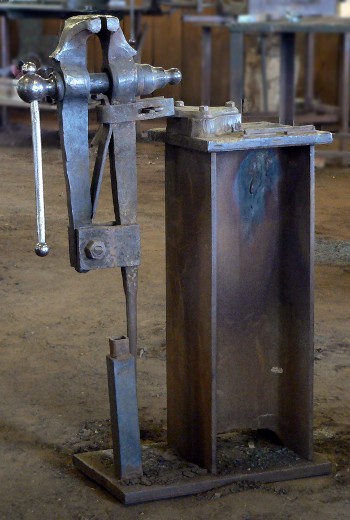
Post vice

Post vice

Tongs

Over time, you’ll need many different tongs, one or two for each thickness of metal that you work with. Having tongs that are the right size for your materials makes it much easier to keep a good grip on your metal and improves the quality of your work. But for starters, you only need about 1-2 pairs, which you can buy for $30-40 each from a blacksmith supplier. After you’ve gained some experience blacksmithing, you’ll be able to make your own tongs. Usually by the end of our two day blacksmithing class, our students are ready to begin learning the skills of tong making.
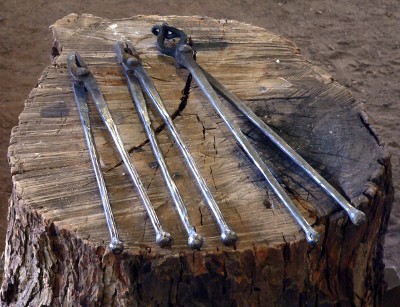
Blacksmith's tongs

Three types of tongs

Other Tools

You’ll also use drifts, slitters, center punches, twisting tools, and chisels. These are all tools that you will be able to make yourself as you develop your skills.
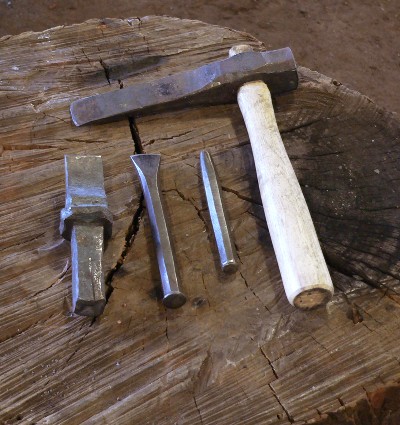
Blacksmith's Tools

Tools made by the blacksmith: hardie cutoff, cold chisel, center punch, and set hotcut


Visit SustainLife journal for more information about the journal.
To subscribe, visit Subscribe to SustainLife.

To learn more, see our online blacksmithing videos and our series of classes on blacksmithing and other traditional skills.